“There are no foreign lands. It is the traveler only who is foreign.” – Robert Louis Stevenson

Tuesday, December 27, 2011

Ghesm Island, Iran

Flying from Shiraz to Ghesm showed amazing lines of dry mountains and winding riverbeds slowly turn into drastic cliffs and scrubby desert.

We landed and were impressed by the tourist information booth ('Seven wonders of the Persian Gulf') and the on site diving incubator! We joined the swarm for a taxi, finally getting in one, we pondered how much it would cost as there was no meter. How hard to bargain? Then we saw that it was 45km to town and were glad we hadn't asked as it would probably have just shocked us! However, as is reasonable Iran, it ended up only being $15.

The view from the Diplomat Hotel in Ghesm town. Hormuz Island is on the horizon but difficult to see.
We got to the Diplomat Hotel whose tiny zoo-like lobby was a fascinating look into the travelers of Ghesm. A sign on the wall warned that all women must wear Islamic dress including the hijab, but a glance around had three very heavily painted women: one with a bandana tied scarf and stray hairs poking out around her bare neck (forbidden), one African looking woman with all purple (colors are frowned upon), and short Capri pants (legs!), and while the third was properly covered, her casual seat on the front steps and her flouncing around in her flowing abaya showed she felt very comfortable around all the many men that overflowed the well-used seats. At first we thought they were prostitutes but then we discovered their plight: they are all women from Dubai on visa runs. We later discovered that one was a Nigerian woman who had been stuck here for a week waiting for her visa and trapped like a prisoner with no money! She told us of someone else who was stuck here for 3 months. They are at the complete mercy of the Dubai government bothering to send them the visa letter fax, and often get stuck with no money and no hopes on this island and more famous Kish Island, both Duty Free ports. They all thought we were insane to be tourists in what they considered a god-forsaken place. It was interesting, if tragic, nevertheless. This is also the first time in a long while that I've had a squatter toilet in my room.

Wow, what a forgotten corner of the world this is! It was touted to be like the gulf was before the oil boom and does seem like it, and we had no idea how large the island was until we got here. 160km of very little except spectacular land formations and wild deserts that must be awfully hot in summer. We sat in our hotel watching the (smuggling) speedboats zip across the harbor contrasting with the newly constructed mosque with half -finished zellij tile decorations going up the 4 minarets, preparing to go to the Portuguese fort here in ancient-but-you-wouldn't-know-it-Ghesm-town.

The stew that is dizi... the mixed vegetables before and after!
We ate a scrumptious local dish for dinner from a little cafe because we couldn't be bothered waiting for the restaurants to open at 8pm. The eating of 'Dizi' is best summed up by the Lonely Planet:

"Getting dizi
Known alternatively as abgusht (or as piti in Azerbaijan, though I never saw it there) dizi is a cheap soup-stew meal named for the earthenware pot in which it's stewed (ours was metal). It's considered by many Iranians as the old of the poor. But assuming you're neither a vegetarian nor obsessive about cholesterol, it's actually a delicious and filling dish. There is, however, an art to eating it. First, drain off the soupy broth into a bowl full of bread that you've previously ripped into bite-sized morsels. Eat this stew the turn to the main ingredients: chickpeas, potatoes, tomatoes, and soft-boiled mutton. Grind these together using a provided metal pestle that looks disturbingly like a stylized toilet plunger. Do include the inevitable chunk of fat; it might look unappetizing but adds to taste and texture. Eat the resulting mush with a spoon or bread."

Day 2

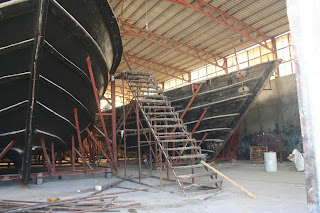
A day to go around the island and see the seven wonders of the gulf. We started off at the dhow yards where we contrasted the wooden ones with the fiberglass ones. It was interesting to see how fiberglass is made. This was the period when Iran was testing nuclear missiles in the Gulf and threatening to close the Straits of Hormuz. We saw many military jets zooming overhead while we criss-crossed the sand piles.

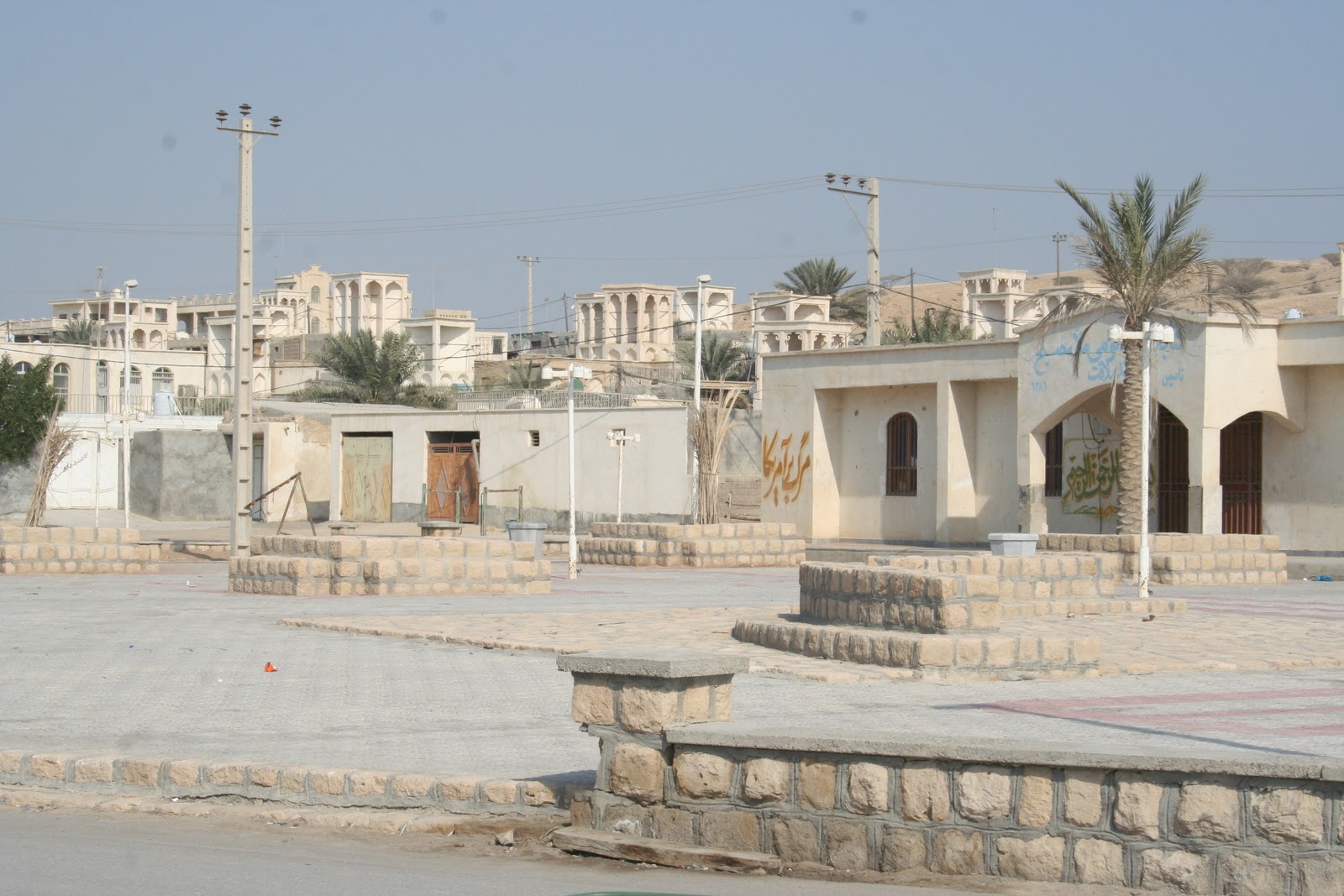
Then we went on to the town of Laft where they are still using the ancient system of air conditioning, the wind towers called bagdirs. It was lovely to see the boats lined up in front of the town as it unfolded down the hill. The mangrove forests were amazing. 9000 square hectares, with dolphins, storks, pelicans, seagulls and other birds. We even prevented our boat driver from pulling a nest out of a particularly old tree.

The view from Khorbas cave.

Valley of the Fallen Stars.
Chah Kuh Valley.
The two geological formations we visited, Chah Kuh Valley and the Valley of Fallen Stars were spectacular. Water erosion has created spectacular winding valleys to walk down and climb up, and we all got as dusty as we could. We finished the day at Khorbas cave which was a couple of houses carved out of the cliff whose tunnels we explored in the dark as the sun had already set.
Day 3

We took a tiny speedboat ferry across to mainland Iran, making bets as to whether they would check our passports (we were thinking of the ladies at the Diplomat Hotel making their escape!). They didn't. No jets or missiles either! We arrived into Bandar Abbas, one of the many bandars (ports) along the coast, and taxied to the little town of Minab, which has a famous Thursday market. Anyone else would think we were crazy to go so far just to see oranges and abayas on sale, but it was a fascinating mix of people, with a snake charmer, toothless old ladies, and an amazing collection of people going about their business.

Day 4

White caps on the sea cancelled our desires to ferry across to see the large fort on Hormuz Island, which we could see in the distance at sunrise and sunset. Instead we lazed in the sun and read.

Monday, December 26, 2011

Persepolis

Persepolis (built by the Achaemenids circa 518 B.C.) and the Necropolis (series of tombs nearby)

Sacked by Alexander the Great in 330 B.C.
Shiraz Fort
Shiraz is a pretty unexciting city, but not bad, I suppose. Not too cool or hot a this time of year. It has many charming tree lined streets, but apart from a small castle fort filled with sour orange trees (yes, we tried them), does not really have much to distinguish it from any other moderately sized city in Iran. And to those who may have dreamed of it, the famous Shiraz grape that hafiz wrote poems about is, of course, no longer grown here.

Necropolis - Naqsh-e Rostam
Necropolis
Tomb of Cyrus the Great
We started the day at the Necropolis... 4 tombs dug out of the rolling geologist's dream of a limestone mountainside similar to Petra. Beautiful reliefs depicting Persians battle wins against their enemies, and a square tower with connections to the solstices. We headed on to Pasagarde 80 km down the road, to ponder Cyrus the Great's tomb on a windswept plain (and the pillaging of it by his own soldiers, which he was very unhappy about) as well as the palaces and massive unexcavated fort of the complex.

Persepolis
I can now finally say that I have been to Persepolis. I remember feeling jealousy that Baku friends had been and I hadn't but it never seemed to make it onto my itinerary despite two previous visits to Iran. It was not as big as I had thought it would be, but I was imagining it to be similar to Palmyra in Syria or Gerash in Jordan. But these expectations were unfair -- it was a special palaces complex and not a living city; and wow, what a complex it would have been. The pillars of one hall were 23m high, and then a roof on top of that! The reliefs carved into the walls, many unfinished as the carving was interrupted by the invasion of Alexander the Great, are among the most spectacular I have ever seen. Because the Achaemenids were so proud of their multicultural nation, there are depictions of 30 different races along with their offerings to the kings, including lions, sheep, goats, camels, stockings, fabric, and other riches. The layers and layers of soldiers are phenomenal, down to the detail on the sword.

I must say, however, how pissed off I got with the management of the complex. While mum mourned that it was not as natural as when she visited 44 years ago (and they have gone overboard in terms of over-manicuring everything), I was constantly being whistled at by the guards for stepping over ropes in order to take a better photo. They had barricaded almost the entire complex off from public viewing (despite carefully crafted pathways showing it was previously ok to go there), and all of those parts included the best bits of course!
View over Persepolis from the tombs
Tombs behind Persepolis
The two tombs behind the complex had spectacular views and the red and pink late afternoon light on the mountains and archways was wonderful. It was great to see the translated languages and the many lion eating deer carvings (I did wonder why they had so many of the same thing).

The complex was covered in sand until the 1930s, which preserved many riches from both raiders and vandals (which Iranians say that the Arabs all were), and we could imagine the wonders that were there before.

We exited to look at the contrast of the Shah's tent city contrasting with the nomadic tents outside the walls, and went home for dinner.  I will say that if I have to eat another plate of chicken kebab and rice, I think I'll go crazy.

Saturday, December 24, 2011

Christmas Greetings 2011


Dear Friends and Family,

As I lie awake exhausted but wide awake from jet lag, I'm reflecting on my year: another truly amazing one, filled with the upheaval of moving and the joys of friendships and travel! I didn't manage a Christmas letter last year, but had a great 2010 with trips to places like Samoa, Kurdistan in Iraq, and Alaska. Spectacular!

Cape Town's Table Mountain
White Sharks!
Penguins on the Cape of Good Hope Peninsula
I started 2011 in Cape Town, South Africa, where I was with my family to share in the celebration of my cousin Cherie's wedding. Had an amazing trip down the Cape of Good Hope peninsula, went out diving with the sharks, and joined a fantastic safari in Hluhluwe-Imflozi National Park (left), where I managed to catch a glimpse of the big 5.
Aside from small trips to the UAE to visit my parents (we had a great trip to the Musandam Peninsula in Oman one weekend), and to the UK for a job fair, the highlights of the first term included trips with friends to amazing Georgia and around picturesque northern Azerbaijan. Georgia, still possibly one of my favorite countries in the world with its warm, welcoming people, glorious good (which I miss considerably), and spectacular scenery, brushed with resilience through hardship.
Marquands on Musandam
Beautiful Tbilisi, Georgia
Azerbaijan near Xinaliq
For the Azeri new year (Novruz), I jetted down to Tanzania (via Dubai, of course!), and caught up with friends in Dar Es Salaam. While not quite fulfilling the dream of climbing Kilimanjaro, I spent a hot few days in Zanzibar diving and catching some sun, while taking many photos of Stonetown.

Stonetown, Zanzibar, Tanzania
My summer was spent visiting friends across North America and I delighted in Canadian cottages, Michigan sand dunes and beaches, VA dinners, DC museums, and even a Dave Matthews concert. I am truly astonished at the number of American foundations that are solely in existence to offer up fantastic lesson plans, courses, and general support for teachers. There was even one offering a free summer course (all you had to pay was transport and they covered room, board and training, and it was great training, too!). Thus I spent a week in Williamsburg, VA with the Foundation for Teaching Economics. If you had told me 5 years ago that I would be teaching Economics, I would have laughed at you, but I find that I love it.


After 3 fantastic years in Azerbaijan, I decided to embark on a new journey, and after pondering many places (thanks for all your tips and advice!), I chose Bogota, Colombia, where I’m working at the Colegio Anglo Colombiano, a bi-lingual school for Colombians. However, before I started, I decided to get my Spanish from non-existent to very basics at a Spanish language school in Antigua, Guatemala. What a gorgeous town it is! There I also visited the Lago de Atitlan and climbed a very active volcano!
Volcanoes from Antigua

Ancient Antigua, Guatemala
Lago de Atitlan
In August I moved to my new country where there are amazing new and old teachers whom I have loved getting to know and share the journey of a new place with. I have rediscovered salsa dancing, and enjoyed the new forms of dance and music like reggaeton, samba, rumba, merengue, etc. I still miss my rock bands in Baku with golden oldies and more, but particularly love the Cuban music in the lovely old suburb of Usaquen. 
Colegio Anglo Colombiano
 I went to the coastal city of Santa Marta (Taganga, left) in October to enjoy beach time with friends where I was introduced to ceviche (a delicious prawn salad mix) and completed my Advanced Open Water -- can't believe I didn't do it years ago - it was easy! I look forward to exploring the diving of the Galapagos, San Andreas, and Gorgona in the near future with whales in migration and other exciting things.
Taganga near Santa Marta

In October Andre got married and I had the wonderful honor of taking the photos. It took place in a romantic Dulwich, London setting. Immediately upon return, I took a group of students to the Colombian Amazon (pics, left). They were an amazing group of students, mostly girls by chance, and we did some fantastic things. I slept in the jungle in an ingenious hammock with mosquito net, rappelled up trees, went hunting for crocodiles and anacondas, saw the pink dolphins, tarantulas capybaras, blue parrots, monkeys, and generally had an amazing time. I think my favorite thing was the bird song in the jungle!
I have arrived into Dubai where I will spend Xmas with my parents and we will jet off to ancient Persepolis and Ghesm Island in Iran. I’m also really looking forward to visiting my old friends in Baku for a week in January as well.

I continue to be inspired by friends across the world's journeys and joie de vivre. Your lust for life is magical! My 2 Jos in Iraq, Graydon and Tamara's multiple bike rides across the world, Cara's marathons, Kate’s, Nick’s and Mum's art. I have also loved seeing other friends move to new places and experiencing the joys of travel. Other friends have had babies and families and it is a gift to watch these new lives emerge on such a fantastic tool as Facebook. I recently swapped over to the FB ‘timeline’ and it was wonderful to be able to go back in time and see all the memories and people that make life worth it!

May you all have Happy Holidays and best wishes for a fantastic 2012 where your dreams come true!
xxoo Natalya
   

Desert Trip to Omani enclave


The desert in Oman is spectacularly beautiful. It is harsh and unyielding, yet in this season picturesque, full of colors and hues and simplicity.

We went on a safari of sorts, 8 cars of Historical Society families from all walks of life. We started at a bat cave after going off road. The one lonely bat flew out in disgust at our disruption of his sleep.

We also saw multiple sand dunes including 'big red'. Driving in the sand is deceptively difficult. The worst place (for embarrassment as well as for towing) is actually on the flat. You cannot lower your revs and it's as slidy as a snowstorm. Walking in sand is not so much fun either. We marveled at the slate mountains and the majestic dunes and wildness.

We picnicked under some Ghaf trees and a hungry camel smelled our gorgeous lunch and wandered over to sample some, so we fed it some leftovers... She even wanted to eat the plate. She stole a cardboard one from the back of someone's open car on her grumbly way out.

We got home well after nightfall while others camped in the desert to stargaze.

Saturday, August 20, 2011

New to Bogota

I've been in Bogota for almost a month now - wow! What a place!

We were put up for a week in the Hill House Hotel in Usaquen -- a great place to stay! Carol and I had the 7th floor - spectacular views over the city from both sides. 

For the first few days we were still under the illusion that this was a warm place and dressed in summer clothing. We froze! I can remember looking around at people and thinking how over dressed they were -- I guess the honeymoon hadn't worn off yet. I am rarely out of my cardigan now! I scoffed at having to wear shoes at school instead of sandals, although I do live in my jandals otherwise.

Anyone who ever laughed at people pulling their socks up - well that's the uniform here! In true teenager style, the girls skirts are also the shortest I've ever seen. It does amuse me when they're holding onto their bums as they walk up the stairs because anyone behind would get a full viewing!

We spent the first week looking at apartments -- talk about driving around and around town! It was great to get to know the cedritos district! I have found a great townhouse with 3 floors -- huge but worth it for the two afternoon-sun balconies!

Furniture shopping! What a mission. Have you ever tried to buy a mattress in a language you don't speak? I was regaled with hards and softs and expensives and cheaps and supporting and firms. Explaining queen (extra-doble), and cheap was a challenge!


I love Colombia because...
people are knowledgable about politics and aware of current events
people are well dressed
people are confident, and have energy in what they do
I feel welcome

Saturday, July 30, 2011

Quick thoughts on Guatemala


It's wonderful that everyone smiles at everyone else. Be friendly to strangers is an essential mantra at makes it such a warm place.

Couples are making out everywhere I go with the grassy areas insider old convents, monasteries and churches being the most popular place. I wondered where they all went today when it rained. They are usually in full make out mode, too. In your lap, hands in your pants kind of deal. It's quite lovely especially after being in such reserved places as the middle east and Azerbaijan, although I suppose the were always lots of couples in public places in Baku, too.

Colors! I love the colors everywhere. The houses are painted, the clothes are patterned, and everything is meant to have color. Baku really was so drab!

The courtyards are wonderful. They are green and leafy and full of flowers in bloom, and there are old ruins everywhere. It appears like they are proud of their history, but I wonder if that's just a front for the tourists. They seem like they have good ideas for usage of space and the ruins in the hotel today were so well integrated with the new. I keep thudding to myself how I would love to find a cute little courtyard house in Colombia!

Sunday, April 10, 2011

Dubai Terminal 2

I'm reading this book at the moment and it's a fascinating look into a journalist's lifestyle. In the very beginning, she is reflecting about travelling constantly and I thought this passage was particularly pertinent considering I was taking off from Terminal 2 in Dubai! Apologies because the excerpt is a bit long.

"Why do it?

I could tell you that it’s a search for truth. I could tell you that when I was a child I loved to read the poems of Robert Louis Stevenson and turn the sheets hanging on the washing like into doors on to faraway places. I could tell you that I felt suffocated by suburbia. I could tell you that I adored Hemmingway and wanted to run with the bulls in Spain, watch big game among the green hills of Africa (though not hunt it), drink mojitos in bars in old Havana and find love behind the lines. I could tell you that once you see others die and evils such as boys turned into killing machines with AK-47s, or families forced to bury stick-limbed girls because they could not afford HIV drugs, one’s own life becomes pretty insignificant.

I could tell you that there is nothing more thrilling than getting on a plane to somewhere you have never been, particularly with a name like Bujumbura or Cochabamba. That used to be true but these days endless security queues have spoiled the magic of airports.

Maybe the truth lies in Dubai Terminal 2. That’s where you go to catch planes to the bad places. The destination board reads Kabul, Baghdad, Mogadishu, and the airlines have names you’ve never even heard of like Chelyabinsk Airlines, Don Airlines, Kam Air, Ossetia, Mahan Air, and Samara Airlines. These are airlines so dodgy that they are not allowed to land at the proper airport. Many, like Arian Afghan Airlines or Reem Air of Kyrgyzstan, are on a list banning them from European airspace and describing them as ‘flying coffins’. Their planes are sold Tupolevs bought second or third hand from Aeroflot or Air India.

The name, Terminal 2, makes it sound as if it is attached to the main airport, but in fact it lies a half-hour’s taxi ride away. It seems in another country entirely to that gleaming glass temple to capitalism where Arabs in white dishdash and sunburnt passengers in shorts and miniskirts shop for Rolex watches and Fendi handbags and buy $100 lottery tickets to win a Jaguar X-type.

At Terminal 2 there is just one shop and people stock up on Mars Bars, tampons and biscuits, for they don’t know what will be available at the other end. Mostly, they are bounty hunters, Afghan moneychangers, aid workers, private security guards and journalists. Instead of smart shiny suitcases they have battered kitbags and rucksacks, black plastic crates of survival equipment, or, in the case of the Afghans large cloth bundles. The ones with briefcases are consultants, being paid thousands of dollars for something called ‘capacity building’, but they will get on a special United Nations plane. Sometimes there are dead bodies being flown back from comfortable exile to be buried in harsh homelands.

Most people have grimly resigned expressions, particularly if like me they are flying Ariana. For the airlines of Terminal 2 departure times mean nothing and it is common to turn up day after day before a plane finally arrives. Besides we all know that the Ariana pilots prefer staying in Dubai to piloting their ‘coffins’back to a destroyed country. We debate with those holding Kam tickets whether it’s safter to fly with an airline that has already crashed or one that always seems about to crash. Passengers that make a fuss and try to find non-existent airline representatives are exposed as newcomers.

Some might be committed do-gooders; others are only doing it for money. ‘George Bush has paid off thousands of mortgages,’ says a Scottish ex-para on his way to be a $1,000-a-day security consultant in Afghanistan after a long stint in Iraq.

But there are a few that have a look on their face that I recognize. It’s a sort of suburban restlessness. Not in a grass-is-always-greener kind of way: but a search for adventure.

Those are the people whose eyes light up when they see the name Kish appear on the destination board. Where is that? Kish Island in Iran, someone tells me. It sounds intriguing. I know I will try to go there. It will mean flying Kish Air which last crashed two years ago.

Biographers of Alexander the Great used the Greek word pothos to describe his endless yearning to be somewhere else, whether it was to cross the Danube, go to the oracle of Ammon, sail the ocean, see the Persian Gulf or untie the legendary knot at Gordium.

I liked that description. But then I read that the longing for something unattainable expressed by pothos could also signify a desire to die. For pothos is also the name for delphiniums, the flowers that Greeks traditionally placed on someone’s tomb.

I never set out to be brave or daring or intrepid or any of those labels often attached to the title, ‘war correspondent’. What I wanted to be is a storyteller. I have been lucky enough to live in countries in Asia, Latin America, Africa, the Middle East and Europe at a time of huge upheaval when the world was adjusting from the cold war to a whole new war of terrorist attacks and suicide bombs.

To me the real story in war is not the bang-bang but the lives of those trying to survive behind the lines.

-Excerpt from the Prologue pp3-5 of ‘Small Wars Permitting: Dispatches from Foreign Lands’ by Christina Lamb ©2008, Harper Press, Harper Collins, London.

Image from Terminal 2 Dubai checkout board.
Image from Sharjah Airport, December 2012, with similarly obscure destinations.