I'm putting my whole trip in one blog entry which makes it enormously long, but such an epic has to go all together! Just warning you… it’s 8 pages in MS Word.
 Friday, December 26, 2008
On the first day we drove SE from Dubai towards the lovely oasis town of Al Ain. Several oases are spread throughout the little border town. Tragically, the oases are drying up because of the lowering of the water table (just imagine the consumption of water it takes to feed thirsty Dubai). On the UAE side, they are feeding the oases with desalinated water trucked up from the coast, but on the Omani side, they can't afford to do that, and are justifiably pissed off because they have to deal with a problem they didn't cause. What to do? The megalomaniacs of Dubai are unlikely to care about such a non-immediate environmental problem that doesn't directly affect them.
 Once across the Mazyed border, we drove on towards Nizwa, stopping briefly at Ibri's charming little fortified village, which was only abandoned in1970 after hundreds of years. While we agreed on its picturesque nature, especially in the golden light of the setting sun, no doubt the draws of concrete (as opposed to mud brick) plumbing and air conditioning made it an easy choice to move.
Pics: Ibri's fortified village
Saturday, December 27
 We left at about 9 to drive towards Nizwa fort where we spent an hour or two wandering around looking at the various holes and crevices of the restored castle. I spent $120 on 8 silver rings, having left all my own in Dubai. There were neat rooms with a special tri-cushion specially made for sitting on the floor. From there to Bahla where we wandered the empty souq at noon prayer-time looking for the indigo man and the pottery sellers. A beautiful mix of old mud brick and new quaint houses meandering past date palm plots, mosques, and empty scrubby desert.
 After that, we drove to Jabrin fort -- a delightful castle reminiscent of the crusader castles in Jordan, full of sun lit lounging rooms with carpets and cushions perfect for lazing away a quiet afternoon, an underground tomb, Al-Humbra palace-like balconies and multiple misleading staircases. Lastly, we drove up the mountain: Jebel Shams. A fun drive up a windy road to a majestic vista of a beautiful dry Grand Canyon-like wadi at the top, where we settled into tent accommodation for the night and wandered off to see the sunset from various locales. It got quite cold as evening descended!

Pics: Nizwa fort, Bahla, Jabrin fort, views of Jebel Shams.
Sunday, December 28

Mum, Daniel and I all started with an early morning walk up Wadi Shams to the abandoned, hanging village of Sap Bani Khamis, which meant a three hour round trip walk up the inside of Oman's Grand Canyon. What an amazing walk! 300 meters of sheer cliffs hanging above you, a sharp drop off of over 1000 below you; surprisingly it didn't feel dangerous, but as a leisurely walk around a valley, including stunning views. The village was gorgeous, too! 15 families lived there till about 30 years ago, in tiny little stone houses built under the cliff overhang. They eked out a living with onions, pomegranates, olives, etc, planted on narrow terraces, the bottom of which falls directly off the cliff to the valley floor a sheer drop below. A little creek flowed through a cave, over a waterfall only to disappear into a little hole and drop under a natural stone bridge thousands of feet above the canyon. They herded sheep, goats, and no doubt chickens too. A small water collection tank, a flour grinder, and the bare trees of an orchard remain to flourish the imagination with a detailed picture of how it must have been to live here. The isolation would have had its blessings and curses no doubt (inter-marriage issues, water/electricity supply, distance from enemies, an ideal view to wakeup to, etc).

We drove back down Jebel Shams through Al Hamra, and back up a spectacular new road to a saddle summit where a ferocious wind was blowing. From there we passed breathless tourists in multiple jeeps ascending what must be the most spectacular mountain road I've ever been on, to get to the lovely villages at the bottom of the wadi near Hatt and Wadi Bani Awf. We were descending the steep, steep inclines in low ratio 4WD on the dusty narrow track in 1st gear, with the nervous passengers on the outer rim looking fearfully straight down the canyon over the edge. No such thing as guard rails! We wondered how they even got the heavy machinery up there to make the road in the first place.

Along the bottom of the wadi, we raced over the unsealed road toward the coastal highway and Muscat, passing other carloads of tourists sweatily getting into wetsuits to swim in the canyon of the wadi to our amusement, since we had already discovered that there was no water! In Muscat we stayed along the corniche near the fish market and just managed to catch the closing of the shops of the souq before bed.
Pics: canyon at sunrise, village and terraces and natural bridge, views from top of drive, Muscat
Monday, December 29


Mum, Dad and I headed out early to go to the bus station and to pay for future nights in the desert, narrowly avoiding the road closures of the GCC conference in town while everyone else toured the fish market and souq for some shopping. Off at around 11, and with a Shell service station's biryani for lunch, we took the new road to Sur via the Bammar sink hole swimming hole. What a neat place to swim! Andre, Daniel and Rory had a blast jumping off the rocks into the deep, brackish water while Jeff-o envisaged a slide rolling down the side. Seeing such a gaping hole made from an underground river's cave falling in makes me wonder just how many caves we were zooming over on the newly built road just in from the coast. Off again, and several badly-signposted wrong turns later, I drove us into Sur Beach Hotel for a sunset gaze over the red-tide infested low tide.
 Pics: sink hole, mountains
Tuesday, December 30
After a delicious breakfast, we headed out to the beautiful green wadi near Tiwi that we had passed the day before. We hiked up the valley across stones where there used to be green gardens. Mum and Dad kept exclaiming about how different it was just two years ago. There was a major cyclone (very unusual for Oman) which blew across the whole region (see PowerPoint) and wiped everything out. At the top of the wadi we swam in a gorgeous refreshing pool. The boys enjoyed jumping off the high cliffs bombing into the water. Then we climbed over several pools and swam under a tunnel to get to a fantastic cave, where of course there was more jumping and tunnels to be had. Normally you have to swim underwater a ways to get to it, but right now the water level is low.

After walking down, we drove through Tiwi and down to the dhow yards of Sur and on to the desert camp near the turtles. After dinner we went out to see the mother turtles coming in to lay their many eggs. Everything's changed since the last time M&D were there—the government has taken over what was chaos and regulated it. We headed out at 8.30 and walked down to the beach in a big group. I must say the parents in our group disgusted me! Talk about leading by a bad example: leaving the torches on the beach when it confuses the turtles, speaking in full volume instead of whispering, and then there was one woman who, when the guide asked if there were any questions, demanded to know when (impatiently) we would see turtles.... Of course it was the same woman that said, when we did eventually see a mother covering her eggs, 'That's it?' I decided that some people should never reproduce!
Pics: wadi, Sur dhow yards, camp
Wednesday, December 31


We got up at 3.30am to go and see the turtles again. Because of it being early, the people were keener and quieter, and it was much more enjoyable. Adding to that, we saw the babies! What gorgeous little things, and it's quite amazing to see the reproduction cycle at work, and the cycle of life with survival of the fittest clearly exhibited! Each mum waits till she's 37 before she returns to the same beach she was born on (hoping that some rich Dubai company hasn't developed it into a hotel or fake island) to lay 100 eggs, returning again for the same two weeks later. There were about 20 mothers laying on our beach that night, but of 1000 eggs, only 4 or 5 baby turtles survive! We sat around one nest of cuties emerging and half couldn't seem to get out of the hole, or got up to the top then rolled back down in their eagerness to live. Stumbling over sand dunes (our footstep holes) twice their size, they were disoriented by the torch lights, and some just headed inland out of idiocy or bad genes. Assuming they make it to the sea (and to do that, they must evade foxes, seagulls, crabs and other predators), the babies have enough energy to swim frantically for 3 days to reach the food and relative safety of deeper waters. Then they may travel the world to such exotic locales as Indonesia, Australia, Mauritius, South Africa or India.

 It was heartbreaking to see one little one make it all the way to the sea, only to be repeatedly swept back by the waves, then scooped up by a passing gull! Aunty Helen rescued one from the dire fate of going inland, and watched it foolishly bob away on the surface instead off diving deep, and then it too was scooped up for a mid-flight snack. That is their fate though, and though we encouraged and assisted as many little ones as we could, acting as bodyguards from other beastly treasures, we could not save them all, and once they disappear into the big blue, we cannot help them at all.
We arrived at our desert camp and amusedly watched everyone else struggle to drive up the sandy incline in front of the camp. One particularly stubborn woman in a Dodge? Lincoln? Mercury went up the hill 6 or 7 times, then was directed by one of the guides to the top, and proceeded to go straight back down again to prove that it was her car and not her driving (or something like that) and couldn't get up for another 6 or 7 tries! Cheering or laughing depending on the attempt, we hoped the people didn't take note of our clothes to harass us at dinnertime.
 We went dune bashing into the sunset. A rather foolish endeavor from the car owner's perspective, it involved driving as speedily as possible up steep golden sand dunes, bouncing through twists and turns, getting stuck in a pit of sand and asking passengers to push the car out, rolling the car from side to side as you swerve through pitching turns, the car yawed shark-like back and forth, bouncing us all almost through the roof and certainly into the doors. It was rounded up by the Grand finale: driving straight down an almost 45 degree slope, which Jeff-o's apt description sums up. 'On that last one, I could see the horizon through the sun roof!' we sand-boarded leisurely down steeped slopes and captured the meeting sun in our hands.


 2008 was rounded up with a delightful Arab drum concert and other festivities organized by the camp. The fantastic band were also a dance troupe: all African descendants, mostly of slaves from Oman's spoils of conquering the East African coast. The dancing was an amazing mix of Arab and African... Dancing in lines with no touching, circles and feet kicks (presumably to remove sand), sashaying randomly with all caliber of energy put into the dancing. White-makeup-faced women were dancing in bright costumes of many layers with blue patterned veils used coquettishly in the motions of movement. The men wiggled their hips and stamped their feet in their sarongs and ceremonial dagger belts. One kept leaping up and then rolling and falling on his knees at everyone's feet to weave a story into the chirpy rhythm. The women gave their mournful yodeling cry, and the men chatted to their brethren and continuously swapped places to ensure an even match to the 6 hardy women. Everyone clapped. Delighted Lebanese women guests in juxtaposing tight jeans with exposed bellies wove between them to donate money as a tip by putting notes on the women's heads. Everyone got up to dance: quite a workout in the deep sand!
Thursday, January 1, 2009

 After a leisurely breakfast at our delightful desert camp, we drove to nearby Ibra to have a wander in their souq and woman's market. After a quick browse through the vegetable and carpentry sections, we decided the old city might be more exciting, so drove off into the distance, eventually meandering our way through tiny alleys and gates that were not intended for SUVs, almost scraping the sides. We found the magical mud- brick township full of derelict old merchants’ homes, palatial and beautifully decorated, but abandoned to the sun and winds. They apparently made their money in the trade with and colonization of Zanzibar, which Oman controlled until the middle of the 20th century. Making homes of mud-brick is one thing, but making them three floors tall is a genuine glory, and they must be the mansions of the times!

A couple of ‘Oman Oil’ stops later (to return our sand-abused tires to normal p.s.i.) we arrived back to the civilization shock that is Muscat. Wow, what should we do when we see a Starbucks and a Dairy Queen?? It's too much to handle! Seafood buffet (which didn't quite meet the glory of the one at Christmas, but was still delicious) and several games of Hearts later (sadly despite my best efforts, I was the loser this time), it was time for bed.
Pics: Ibri's mud-brick homes
Friday, January 2
After yet another delicious buffet breakfast, we discovered someone had forced open the windows of the jeep overnight. Luckily, nothing appeared to be taken. While that was being fixed, I discovered that a dear friend from my childhood in Queenstown (Lauren Kelly Stoneley) was killed in a car accident over the xmas holidays. What a tragedy! So young, and her poor little boy!
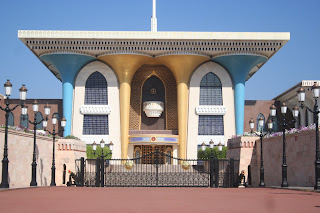 We drove from our place which was almost on the beach, past Ruwi, and 'downtown' (Muttrah) to old Muscat and the Sultan's palace. It’s a 70's monstrosity of blue and gold pillars, but perfectly appropriate for a new age prince. Most of the old city had completely lost any quaintness however, but the next bay over was much more charming, and also clearly more poor. We attempted to drive into the major Shangri-La hotel and a neighboring Dive Center beach, but the colossal prices were off-putting, no doubt as they intended! USD30 just to drive the car in! We eventually found a little cove with a fishing village and had a wander along the coastline.
Unfortunately, most of northern Oman has the Red Tide, which is an algae that turns the water a soupy red color. Because it sucks oxygen out of the water, it kills fish and coral, and this year it has lasted two more months than usual. It is bad to swim in, and everything is affected! Poor Oman.
 After a leisurely wander around the beach and shops near our hotel during the afternoon (it was Friday after all, so nothing is open) we went back to the souq for dinner and a forage in the silver shops. Many beautiful rings and other jewelry is old-looking and hand-made, so we all sat down at the over-flowing baskets of dusty creations to blackened our hands with finding that perfect item. Mum and I are still debating if it truly is old, or just recreated. I found a replica of my Create pendant there, and it is impossible to doubt that much of it is made in India. The sad thing is that the south Asians dominate the selling and shopping instead of the traditional Arabs, and as two cruise ships were in town, the prices were vastly inflated and the shopkeepers impatient.
Pics: Sultan's palace, fishing village
Saturday, January 3

Rising at the crack of dawn, M&D drove me to the bus station and put me on the 12 hour slog to Salalah. It passes through the mountains then passes through a huge amount of flat, empty desert. It was fascinating to see the sheer number of camel crossing signs (yet no camels) and the random ambulance that passed us, sirens screaming, that we later passed and picked up the driver of! Where on earth is it coming from and even more puzzling, where is it going? There is absolutely nothing out there.
As a solo female traveler, I am a focus for curiosity and puzzlement. At Oman pit stops, females are required to enter through the 'family entrance'. Only men may enter the front door. This is not to exclude women but to protect them. If I had insisted on entering the front door, I would be allowed in, but honestly, the stares of the many men just wouldn't make it worth it. A young woman invited me to eat with her and was astounded that I was travelling alone, even more astounded that I was in Oman alone, and in a hotel alone. She was sure I would get bored with all the time by myself. I am such an enigma! After the typical biryani, I shuffled back onto the bus again.
Arriving into Salalah just before sunset was like arriving into a deserted Wild West ghost town. There are many empty lots and very few people, but as it is not the Khareef (monsoon) season, there are very few people here. I wandered across the street to my charming hotel where I settled in while watching ‘Enigma’, some cold war film from the70s with Martin Sheen as the star East German. I had a wander to the Indian shopping center nearby, and then around the little shops downtown.
Pics camel crossing and desert
Sunday, January 4
Sleeping in a bit (despite also sleeping on the bus all the previous day) I enjoyed my continental breakfast and had a wander of town, eventually succumbing to one of to the obnoxious beeping taxi drivers who drove me down to Al-Baleed, the old city ruins. A huge expanse right of the sea's edge, it has been designed so that the rich Arab visitors can ride around it on electric golf carts. Not much is there other than a giant pile of rocks, although they have uncovered the remains of many mosques, which would typically have been the most permanent of structures. As I wandered through the thick dust I wondered if it was the remains of ornate mud brick homes. A new museum has been setup, and it seemed that everything in there was a copy of something in a European museum. London, Paris, Germany... What disgusting hoarders the colonists were (are), or else far-sighted culturally interested people, supplying examples for their future generations.


After buying an Oman calendar (ironically, produced in Dubai), I snuck out through a hole in the fence to the glorious beach beyond. Miles and miles of empty white sand (albeit pockmarked by many sets of tire tracks) was all mine -- not another soul was within shouting distance. Cursing that I'd left my togs back at the hotel, I had a swim in my shirt and undies instead --- delicious water, but a fierce wind, which while cold, made for a quick dry off.
 I strolled back to town past the derelict old houses and boarded up restaurants, and pondered how obnoxious the busy season would be. As it was, it felt truly like a ghost town, with almost no people around. Reaching the Sultan's beach-side palace with nary an inch of shade in sight, I gazed out at the birds and stalks feeding on fish and crabs. Wandering through a reawakening souq, I was disappointed to find nothing of interest. At the gold and silver souq closer to town, I had success however! A quaint little burger place provided dinner.
Pics: Al Baleed, town
Monday, January 5
 I met a girl at breakfast. Her name was Claire and she was a solo female traveler like me, so I invited her to come along with me in my rent a car. To think, she was going to try the microbuses! Now, that's intrepid.
 Off we went in the direction of Mirbat. What a town! If I ever thought Salalah was an outpost at the end of the world, Mirbat is worse. The site of a major battle between the Marxist rebels and Sultan Qaboos' government forces in the 1970s, it was supposed to have a fort. We found three sort-of-fort-like buildings, one of which was titled castle but had fallen in on one side and was boarded shut. Other than that there wasn't so much in the forgotten town... That was until I found my favorite abandoned mud-brick house in all of Oman.
  This delightful, derelict structure had intact stairs leading all the way to the third floor! It had turret style roof edges, beautiful wooden lattice windows, and the best part were the fantastic decorations still intact in each room, with the best being the third floor of course, which has spirals and coils lined all over the walls, carved doors, window frames and pillars, painted ceilings and beams. The view out the windows was of the sea, the courtyard or to an almost equally delightful similar house next door. Why oh why is concrete and air-conditioning seen as better? Why couldn't they preserve their old homes instead of abandoning them to the elements and raiders, squatters, animals and other vandals?


From there we drove to Khor Rhori. The northern turn off, it turns out, is the wrong one. After being in jeeps and 4WDs for the last 10 days, I am unused to a regular car's capabilities, but I took it off-road, certainly over places I shouldn't have. At one point I was unsure of the path, but it was too late to go back, although we eventually did made it. Khor Rhori was the amazing frankincense port of Samhan in history, with a beautiful harbor that is now blocked off by a sand bar. We stopped for a while on the sand bar for a paddle and a swim, the drove on up Jebel Samhan to a sinkhole and Wadi Dharbat, a dry waterfall near a green valley with many strolling camels near the town of Tawi Allei.

At around 4 o'clock we pulled into Taqah to visit its two forts/castles, which had unfortunately locked up for the day. As we were driving back we passed 20 or 30 fishermen pulling in their nets on the shore, near 5 or 6 trucks parked on the sand. Huge flocks of gulls circled greedily, swinging down to swoop away some of the catch as it came to the surface because of the nets. Other dumb birds just crowded around to watch and got nothing. They squawked all the way up the beach and their excitement was palpable.
Pics: abandoned house in Mirbat, Khori beach, fort, fishermen
 We were out the door by 9, headed on a much more picturesque road toward the Yemen border. Inland for the first while, we eventually hit a gorgeous beach: Mughsail.
  From there, a majestic snaking road up to 1000m, right above the sea. We passed a military checkpoint and then went a bit further, where it was rolling plateau inland. We didn't reach the border as it was a further 70km, but turned around to head back to the beach. From the beach there's a walk up to some blowholes, which sadly were not blowing because the sea was calm. Lunch in a cute seaside restaurant (I was going to say bistro but that's probably going too far!), and then a swim, while the fisherman drove up and down the enormous line of sand looking for schools of fish to throw their nets at. A peaceful drive back and a drink at the Hilton brought us home at sunset. Dinner at Al-Fareed's--Indian food or the typical kebab fare is all that we seem to be able to find in Oman, although ironically, this place also had Chinese!
Pics: cliffs, beach, mountain road


Wednesday, January 7
My last full weekday in Oman began with some errands, the most important of which was the post office. I also discovered that because they've created the new museum at Al-Baleed, the old one is empty, save the (very interesting) photos by Wilfred Thesiger of the Dhofar area before his camel trek across the Empty Quarter. Unfortunately, a child's festival and exhibition was taking place so the photos were in storage.
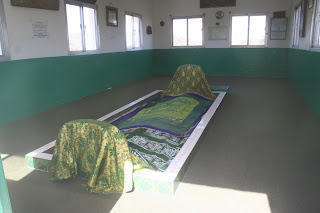
 From there I drove to the Prophet Job's tomb: a very unremarkable building in a remarkable place. It's incredibly important to Islam, perhaps even the holiest place in this part of Oman, but other than being very long, is not the most exciting tomb I've ever seen. However, I can quite admire its humbleness. It is perched high on the edge of the mountains directly behind Salalah, and after several wrong turns taking me to a random farmyard, I made it. The view from the parking would have been spectacular, gazing over the plains to the sea with a clear image of Salalah, but it was hazy and the hills are an ugly brown at this time of year.
I headed back to Taqa fort to see what I had missed before. It's been beautifully restored, albeit with concrete instead of the traditional mud-brick, and each room decorated how it would have looked with any traditional artifacts. Interestingly, it was more a castle than a fort, with the main military garrison being on top of the hill behind. It was a castle in the sense that it belonged to one important family, and the rooms they lived in, complete with master bed and baby's cradle. I forgot to look for Sultan Qaboos' mother's grave, but drove back in search of Prophet Salem's camel's footprints instead. I never did find them! They've hidden in a suburb of Salalah, and to be fair, I can't say I know who Salem is anyway, though I was curious to see how they'd preserved the footprints.
Instead, I drove on, down the main street of Salalah, As-Salam Street, passing little dinky little shops, a disproportionate number of hairdressers, but most things were closed for the siesta. My destination was a bird preserve at the western end of town, were there are many storks, flamingoes, and other protected avians.
Unfortunately, I couldn't see many, but enjoyed the beach instead, in its vast, empty, wild expanse. The last order of the day was exploring Salalah's retail opportunities. The ‘Centrepoint’ chain provided me with some much needed new sandals, and then I watched the beginning of the Iraq-Oman soccer game from the luxury coffee shop downtown, Browniz, whose Lebanese owners were staying in our hotel in Muscat.
Pics: Taqa fort, view from Ayub's tomb
Thursday, January 8
After breakfast I tried the handicrafts market, but unfortunately it was closed for the day/month/whatever. After some email time and a trip to the ATM, my rental car company came to collect me to go to the airport. The charming Indian man who was the manager told me he’d been in Salalah 8 years and absolutely loved it there. He said it was a great place to live because he had his family with him and he had lots of time off. Compared with his hard-working, mistreated friends and relatives in Dubai, no doubt it must have enormous appeal, which is quite ironic considering that most westerners would prefer the excitement of Dubai to the boredom of Salalah. Different places in life generate different needs, I guess.
I had a long time in tiny Salalah airport, and then, once in Muscat, I caught the 6-hour bus back to Dubai. It’s an enormous border crossing (a very wide no-man’s-land through hills and canyons). The Dubai bus station is in Deira, where my parents were waiting in the smokiest Shisha café, where, to the vastly over-eager owner, my father said that I was married for the first time in my life.
If you've gotten this far, you certainly deserve to see the rest of the photos if you're interested: They're on facebook and anyone can access them: http://www.facebook.com/album.php?aid=204140&l=466fb&id=668335330, here http://www.facebook.com/album.php?aid=204172&l=2622a&id=668335330, and here http://www.facebook.com/album.php?aid=204635&l=59482&id=668335330
 Friday, December 26, 2008
On the first day we drove SE from Dubai towards the lovely oasis town of Al Ain. Several oases are spread throughout the little border town. Tragically, the oases are drying up because of the lowering of the water table (just imagine the consumption of water it takes to feed thirsty Dubai). On the UAE side, they are feeding the oases with desalinated water trucked up from the coast, but on the Omani side, they can't afford to do that, and are justifiably pissed off because they have to deal with a problem they didn't cause. What to do? The megalomaniacs of Dubai are unlikely to care about such a non-immediate environmental problem that doesn't directly affect them.

 Once across the Mazyed border, we drove on towards Nizwa, stopping briefly at Ibri's charming little fortified village, which was only abandoned in1970 after hundreds of years. While we agreed on its picturesque nature, especially in the golden light of the setting sun, no doubt the draws of concrete (as opposed to mud brick) plumbing and air conditioning made it an easy choice to move.
 Pics: Ibri's fortified village
Saturday, December 27
 We left at about 9 to drive towards Nizwa fort where we spent an hour or two wandering around looking at the various holes and crevices of the restored castle. I spent $120 on 8 silver rings, having left all my own in Dubai. There were neat rooms with a special tri-cushion specially made for sitting on the floor. From there to Bahla where we wandered the empty souq at noon prayer-time looking for the indigo man and the pottery sellers. A beautiful mix of old mud brick and new quaint houses meandering past date palm plots, mosques, and empty scrubby desert.
 After that, we drove to Jabrin fort -- a delightful castle reminiscent of the crusader castles in Jordan, full of sun lit lounging rooms with carpets and cushions perfect for lazing away a quiet afternoon, an underground tomb, Al-Humbra palace-like balconies and multiple misleading staircases. Lastly, we drove up the mountain: Jebel Shams. A fun drive up a windy road to a majestic vista of a beautiful dry Grand Canyon-like wadi at the top, where we settled into tent accommodation for the night and wandered off to see the sunset from various locales. It got quite cold as evening descended!

Pics: Nizwa fort, Bahla, Jabrin fort, views of Jebel Shams.
Sunday, December 28


Mum, Daniel and I all started with an early morning walk up Wadi Shams to the abandoned, hanging village of Sap Bani Khamis, which meant a three hour round trip walk up the inside of Oman's Grand Canyon. What an amazing walk! 300 meters of sheer cliffs hanging above you, a sharp drop off of over 1000 below you; surprisingly it didn't feel dangerous, but as a leisurely walk around a valley, including stunning views. The village was gorgeous, too! 15 families lived there till about 30 years ago, in tiny little stone houses built under the cliff overhang. They eked out a living with onions, pomegranates, olives, etc, planted on narrow terraces, the bottom of which falls directly off the cliff to the valley floor a sheer drop below. A little creek flowed through a cave, over a waterfall only to disappear into a little hole and drop under a natural stone bridge thousands of feet above the canyon. They herded sheep, goats, and no doubt chickens too. A small water collection tank, a flour grinder, and the bare trees of an orchard remain to flourish the imagination with a detailed picture of how it must have been to live here. The isolation would have had its blessings and curses no doubt (inter-marriage issues, water/electricity supply, distance from enemies, an ideal view to wakeup to, etc).
We drove back down Jebel Shams through Al Hamra, and back up a spectacular new road to a saddle summit where a ferocious wind was blowing. From there we passed breathless tourists in multiple jeeps ascending what must be the most spectacular mountain road I've ever been on, to get to the lovely villages at the bottom of the wadi near Hatt and Wadi Bani Awf. We were descending the steep, steep inclines in low ratio 4WD on the dusty narrow track in 1st gear, with the nervous passengers on the outer rim looking fearfully straight down the canyon over the edge. No such thing as guard rails! We wondered how they even got the heavy machinery up there to make the road in the first place.

Along the bottom of the wadi, we raced over the unsealed road toward the coastal highway and Muscat, passing other carloads of tourists sweatily getting into wetsuits to swim in the canyon of the wadi to our amusement, since we had already discovered that there was no water! In Muscat we stayed along the corniche near the fish market and just managed to catch the closing of the shops of the souq before bed.
Pics: canyon at sunrise, village and terraces and natural bridge, views from top of drive, Muscat
Monday, December 29


Mum, Dad and I headed out early to go to the bus station and to pay for future nights in the desert, narrowly avoiding the road closures of the GCC conference in town while everyone else toured the fish market and souq for some shopping. Off at around 11, and with a Shell service station's biryani for lunch, we took the new road to Sur via the Bammar sink hole swimming hole. What a neat place to swim! Andre, Daniel and Rory had a blast jumping off the rocks into the deep, brackish water while Jeff-o envisaged a slide rolling down the side. Seeing such a gaping hole made from an underground river's cave falling in makes me wonder just how many caves we were zooming over on the newly built road just in from the coast. Off again, and several badly-signposted wrong turns later, I drove us into Sur Beach Hotel for a sunset gaze over the red-tide infested low tide.
 Pics: sink hole, mountains
Tuesday, December 30

After a delicious breakfast, we headed out to the beautiful green wadi near Tiwi that we had passed the day before. We hiked up the valley across stones where there used to be green gardens. Mum and Dad kept exclaiming about how different it was just two years ago. There was a major cyclone (very unusual for Oman) which blew across the whole region (see PowerPoint) and wiped everything out. At the top of the wadi we swam in a gorgeous refreshing pool. The boys enjoyed jumping off the high cliffs bombing into the water. Then we climbed over several pools and swam under a tunnel to get to a fantastic cave, where of course there was more jumping and tunnels to be had. Normally you have to swim underwater a ways to get to it, but right now the water level is low.

After walking down, we drove through Tiwi and down to the dhow yards of Sur and on to the desert camp near the turtles.
 After dinner we went out to see the mother turtles coming in to lay their many eggs. Everything's changed since the last time M&D were there—the government has taken over what was chaos and regulated it. We headed out at 8.30 and walked down to the beach in a big group. I must say the parents in our group disgusted me! Talk about leading by a bad example: leaving the torches on the beach when it confuses the turtles, speaking in full volume instead of whispering, and then there was one woman who, when the guide asked if there were any questions, demanded to know when (impatiently) we would see turtles.... Of course it was the same woman that said, when we did eventually see a mother covering her eggs, 'That's it?' I decided that some people should never reproduce!
Pics: wadi, Sur dhow yards, camp
Wednesday, December 31


We got up at 3.30am to go and see the turtles again. Because of it being early, the people were keener and quieter, and it was much more enjoyable. Adding to that, we saw the babies! What gorgeous little things, and it's quite amazing to see the reproduction cycle at work, and the cycle of life with survival of the fittest clearly exhibited! Each mum waits till she's 37 before she returns to the same beach she was born on (hoping that some rich Dubai company hasn't developed it into a hotel or fake island) to lay 100 eggs, returning again for the same two weeks later. There were about 20 mothers laying on our beach that night, but of 1000 eggs, only 4 or 5 baby turtles survive! We sat around one nest of cuties emerging and half couldn't seem to get out of the hole, or got up to the top then rolled back down in their eagerness to live. Stumbling over sand dunes (our footstep holes) twice their size, they were disoriented by the torch lights, and some just headed inland out of idiocy or bad genes. Assuming they make it to the sea (and to do that, they must evade foxes, seagulls, crabs and other predators), the babies have enough energy to swim frantically for 3 days to reach the food and relative safety of deeper waters. Then they may travel the world to such exotic locales as Indonesia, Australia, Mauritius, South Africa or India.

 It was heartbreaking to see one little one make it all the way to the sea, only to be repeatedly swept back by the waves, then scooped up by a passing gull! Aunty Helen rescued one from the dire fate of going inland, and watched it foolishly bob away on the surface instead off diving deep, and then it too was scooped up for a mid-flight snack. That is their fate though, and though we encouraged and assisted as many little ones as we could, acting as bodyguards from other beastly treasures, we could not save them all, and once they disappear into the big blue, we cannot help them at all.
After a morning snooze and a bracingly cold shower, we headed off down the coast through quaint, hardy, fishing villages that had a distinct feeling of the Wild West. Ornate, worn, carved doors hid behind crumbling concrete archways, derelict half-toppled mud-brick walls sat astride the road beside Toyota trucks with faded stripes that looked either faintly abused or well-loved but certainly as if they had a hard life. Men in dishdashas and Omani headscarves at one service station wanted to sweep me away to some stifling marriage or other such pedestal!
We arrived at our desert camp and amusedly watched everyone else struggle to drive up the sandy incline in front of the camp. One particularly stubborn woman in a Dodge? Lincoln? Mercury went up the hill 6 or 7 times, then was directed by one of the guides to the top, and proceeded to go straight back down again to prove that it was her car and not her driving (or something like that) and couldn't get up for another 6 or 7 tries! Cheering or laughing depending on the attempt, we hoped the people didn't take note of our clothes to harass us at dinnertime.
 We went dune bashing into the sunset. A rather foolish endeavor from the car owner's perspective, it involved driving as speedily as possible up steep golden sand dunes, bouncing through twists and turns, getting stuck in a pit of sand and asking passengers to push the car out, rolling the car from side to side as you swerve through pitching turns, the car yawed shark-like back and forth, bouncing us all almost through the roof and certainly into the doors. It was rounded up by the Grand finale: driving straight down an almost 45 degree slope, which Jeff-o's apt description sums up. 'On that last one, I could see the horizon through the sun roof!' we sand-boarded leisurely down steeped slopes and captured the meeting sun in our hands.


 2008 was rounded up with a delightful Arab drum concert and other festivities organized by the camp. The fantastic band were also a dance troupe: all African descendants, mostly of slaves from Oman's spoils of conquering the East African coast. The dancing was an amazing mix of Arab and African... Dancing in lines with no touching, circles and feet kicks (presumably to remove sand), sashaying randomly with all caliber of energy put into the dancing. White-makeup-faced women were dancing in bright costumes of many layers with blue patterned veils used coquettishly in the motions of movement. The men wiggled their hips and stamped their feet in their sarongs and ceremonial dagger belts. One kept leaping up and then rolling and falling on his knees at everyone's feet to weave a story into the chirpy rhythm. The women gave their mournful yodeling cry, and the men chatted to their brethren and continuously swapped places to ensure an even match to the 6 hardy women. Everyone clapped. Delighted Lebanese women guests in juxtaposing tight jeans with exposed bellies wove between them to donate money as a tip by putting notes on the women's heads. Everyone got up to dance: quite a workout in the deep sand!
Pic. Turtles, mum and babies, sunrise, desert camp, dune bashing, sun in hands, sitting on rise of sand
Thursday, January 1, 2009

 After a leisurely breakfast at our delightful desert camp, we drove to nearby Ibra to have a wander in their souq and woman's market. After a quick browse through the vegetable and carpentry sections, we decided the old city might be more exciting, so drove off into the distance, eventually meandering our way through tiny alleys and gates that were not intended for SUVs, almost scraping the sides. We found the magical mud- brick township full of derelict old merchants’ homes, palatial and beautifully decorated, but abandoned to the sun and winds. They apparently made their money in the trade with and colonization of Zanzibar, which Oman controlled until the middle of the 20th century. Making homes of mud-brick is one thing, but making them three floors tall is a genuine glory, and they must be the mansions of the times!
A couple of ‘Oman Oil’ stops later (to return our sand-abused tires to normal p.s.i.) we arrived back to the civilization shock that is Muscat. Wow, what should we do when we see a Starbucks and a Dairy Queen?? It's too much to handle! Seafood buffet (which didn't quite meet the glory of the one at Christmas, but was still delicious) and several games of Hearts later (sadly despite my best efforts, I was the loser this time), it was time for bed.
Pics: Ibri's mud-brick homes
Friday, January 2
After yet another delicious buffet breakfast, we discovered someone had forced open the windows of the jeep overnight. Luckily, nothing appeared to be taken. While that was being fixed, I discovered that a dear friend from my childhood in Queenstown (Lauren Kelly Stoneley) was killed in a car accident over the xmas holidays. What a tragedy! So young, and her poor little boy!
 We drove from our place which was almost on the beach, past Ruwi, and 'downtown' (Muttrah) to old Muscat and the Sultan's palace. It’s a 70's monstrosity of blue and gold pillars, but perfectly appropriate for a new age prince. Most of the old city had completely lost any quaintness however, but the next bay over was much more charming, and also clearly more poor. We attempted to drive into the major Shangri-La hotel and a neighboring Dive Center beach, but the colossal prices were off-putting, no doubt as they intended! USD30 just to drive the car in! We eventually found a little cove with a fishing village and had a wander along the coastline.
Unfortunately, most of northern Oman has the Red Tide, which is an algae that turns the water a soupy red color. Because it sucks oxygen out of the water, it kills fish and coral, and this year it has lasted two more months than usual. It is bad to swim in, and everything is affected! Poor Oman.
 After a leisurely wander around the beach and shops near our hotel during the afternoon (it was Friday after all, so nothing is open) we went back to the souq for dinner and a forage in the silver shops. Many beautiful rings and other jewelry is old-looking and hand-made, so we all sat down at the over-flowing baskets of dusty creations to blackened our hands with finding that perfect item. Mum and I are still debating if it truly is old, or just recreated. I found a replica of my Create pendant there, and it is impossible to doubt that much of it is made in India. The sad thing is that the south Asians dominate the selling and shopping instead of the traditional Arabs, and as two cruise ships were in town, the prices were vastly inflated and the shopkeepers impatient.
 Pics: Sultan's palace, fishing village
Saturday, January 3


Rising at the crack of dawn, M&D drove me to the bus station and put me on the 12 hour slog to Salalah. It passes through the mountains then passes through a huge amount of flat, empty desert. It was fascinating to see the sheer number of camel crossing signs (yet no camels) and the random ambulance that passed us, sirens screaming, that we later passed and picked up the driver of! Where on earth is it coming from and even more puzzling, where is it going? There is absolutely nothing out there.
As a solo female traveler, I am a focus for curiosity and puzzlement. At Oman pit stops, females are required to enter through the 'family entrance'. Only men may enter the front door. This is not to exclude women but to protect them. If I had insisted on entering the front door, I would be allowed in, but honestly, the stares of the many men just wouldn't make it worth it. A young woman invited me to eat with her and was astounded that I was travelling alone, even more astounded that I was in Oman alone, and in a hotel alone. She was sure I would get bored with all the time by myself. I am such an enigma! After the typical biryani, I shuffled back onto the bus again.
Arriving into Salalah just before sunset was like arriving into a deserted Wild West ghost town. There are many empty lots and very few people, but as it is not the Khareef (monsoon) season, there are very few people here. I wandered across the street to my charming hotel where I settled in while watching ‘Enigma’, some cold war film from the70s with Martin Sheen as the star East German. I had a wander to the Indian shopping center nearby, and then around the little shops downtown.
Pics camel crossing and desert
Sunday, January 4
Sleeping in a bit (despite also sleeping on the bus all the previous day) I enjoyed my continental breakfast and had a wander of town, eventually succumbing to one of to the obnoxious beeping taxi drivers who drove me down to Al-Baleed, the old city ruins. A huge expanse right of the sea's edge, it has been designed so that the rich Arab visitors can ride around it on electric golf carts. Not much is there other than a giant pile of rocks, although they have uncovered the remains of many mosques, which would typically have been the most permanent of structures. As I wandered through the thick dust I wondered if it was the remains of ornate mud brick homes. A new museum has been setup, and it seemed that everything in there was a copy of something in a European museum. London, Paris, Germany... What disgusting hoarders the colonists were (are), or else far-sighted culturally interested people, supplying examples for their future generations.


After buying an Oman calendar (ironically, produced in Dubai), I snuck out through a hole in the fence to the glorious beach beyond. Miles and miles of empty white sand (albeit pockmarked by many sets of tire tracks) was all mine -- not another soul was within shouting distance. Cursing that I'd left my togs back at the hotel, I had a swim in my shirt and undies instead --- delicious water, but a fierce wind, which while cold, made for a quick dry off.
 I strolled back to town past the derelict old houses and boarded up restaurants, and pondered how obnoxious the busy season would be. As it was, it felt truly like a ghost town, with almost no people around. Reaching the Sultan's beach-side palace with nary an inch of shade in sight, I gazed out at the birds and stalks feeding on fish and crabs. Wandering through a reawakening souq, I was disappointed to find nothing of interest. At the gold and silver souq closer to town, I had success however! A quaint little burger place provided dinner.
Pics: Al Baleed, town
Monday, January 5
 I met a girl at breakfast. Her name was Claire and she was a solo female traveler like me, so I invited her to come along with me in my rent a car. To think, she was going to try the microbuses! Now, that's intrepid.
  Off we went in the direction of Mirbat. What a town! If I ever thought Salalah was an outpost at the end of the world, Mirbat is worse. The site of a major battle between the Marxist rebels and Sultan Qaboos' government forces in the 1970s, it was supposed to have a fort. We found three sort-of-fort-like buildings, one of which was titled castle but had fallen in on one side and was boarded shut. Other than that there wasn't so much in the forgotten town... That was until I found my favorite abandoned mud-brick house in all of Oman.
  This delightful, derelict structure had intact stairs leading all the way to the third floor! It had turret style roof edges, beautiful wooden lattice windows, and the best part were the fantastic decorations still intact in each room, with the best being the third floor of course, which has spirals and coils lined all over the walls, carved doors, window frames and pillars, painted ceilings and beams. The view out the windows was of the sea, the courtyard or to an almost equally delightful similar house next door. Why oh why is concrete and air-conditioning seen as better? Why couldn't they preserve their old homes instead of abandoning them to the elements and raiders, squatters, animals and other vandals?

From there we drove to Khor Rhori. The northern turn off, it turns out, is the wrong one. After being in jeeps and 4WDs for the last 10 days, I am unused to a regular car's capabilities, but I took it off-road, certainly over places I shouldn't have. At one point I was unsure of the path, but it was too late to go back, although we eventually did made it. Khor Rhori was the amazing frankincense port of Samhan in history, with a beautiful harbor that is now blocked off by a sand bar. We stopped for a while on the sand bar for a paddle and a swim, the drove on up Jebel Samhan to a sinkhole and Wadi Dharbat, a dry waterfall near a green valley with many strolling camels near the town of Tawi Allei.

At around 4 o'clock we pulled into Taqah to visit its two forts/castles, which had unfortunately locked up for the day. As we were driving back we passed 20 or 30 fishermen pulling in their nets on the shore, near 5 or 6 trucks parked on the sand. Huge flocks of gulls circled greedily, swinging down to swoop away some of the catch as it came to the surface because of the nets. Other dumb birds just crowded around to watch and got nothing. They squawked all the way up the beach and their excitement was palpable.
Pics: abandoned house in Mirbat, Khori beach, fort, fishermen

Tuesday, January 6
Was up with the usual hotel construction (a 7:45am jack-hammering beside my ear), and another simple 'continental breakfast' (toast and tea). Met an interesting German guy who had cycled down to Salalah from Dubai. It certainly put my 12 hour bus ride into perspective!
 We were out the door by 9, headed on a much more picturesque road toward the Yemen border. Inland for the first while, we eventually hit a gorgeous beach: Mughsail.
  From there, a majestic snaking road up to 1000m, right above the sea. We passed a military checkpoint and then went a bit further, where it was rolling plateau inland. We didn't reach the border as it was a further 70km, but turned around to head back to the beach. From the beach there's a walk up to some blowholes, which sadly were not blowing because the sea was calm. Lunch in a cute seaside restaurant (I was going to say bistro but that's probably going too far!), and then a swim, while the fisherman drove up and down the enormous line of sand looking for schools of fish to throw their nets at. A peaceful drive back and a drink at the Hilton brought us home at sunset. Dinner at Al-Fareed's--Indian food or the typical kebab fare is all that we seem to be able to find in Oman, although ironically, this place also had Chinese!
 Pics: cliffs, beach, mountain road


Wednesday, January 7
My last full weekday in Oman began with some errands, the most important of which was the post office. I also discovered that because they've created the new museum at Al-Baleed, the old one is empty, save the (very interesting) photos by Wilfred Thesiger of the Dhofar area before his camel trek across the Empty Quarter. Unfortunately, a child's festival and exhibition was taking place so the photos were in storage.

 From there I drove to the Prophet Job's tomb: a very unremarkable building in a remarkable place. It's incredibly important to Islam, perhaps even the holiest place in this part of Oman, but other than being very long, is not the most exciting tomb I've ever seen. However, I can quite admire its humbleness. It is perched high on the edge of the mountains directly behind Salalah, and after several wrong turns taking me to a random farmyard, I made it. The view from the parking would have been spectacular, gazing over the plains to the sea with a clear image of Salalah, but it was hazy and the hills are an ugly brown at this time of year.

I headed back to Taqa fort to see what I had
 missed before. It's been beautifully restored, albeit with concrete instead of the traditional mud-brick, and each room decorated how it would have looked with any traditional artifacts. Interestingly, it was more a castle than a fort, with the main military garrison being on top of the hill behind. It was a castle in the sense that it belonged to one important family, and the rooms they lived in, complete with master bed and baby's cradle. I forgot to look for Sultan Qaboos' mother's grave, but drove back in search of Prophet Salem's camel's footprints instead. I never did find them! They've hidden in a suburb of Salalah, and to be fair, I can't say I know who Salem is anyway, though I was curious to see how they'd preserved the footprints.
Instead, I drove on, down the main street of Salalah, As-Salam Street, passing little dinky little shops, a disproportionate number of hairdressers, but most things were closed for the siesta. My destination was a bird preserve at the western end of town, were there are many storks, flamingoes, and other protected avians.
Unfortunately, I couldn't see many, but enjoyed the beach instead, in its vast, empty, wild expanse. The last order of the day was exploring Salalah's retail opportunities. The ‘Centrepoint’ chain provided me with some much needed new sandals, and then I watched the beginning of the Iraq-Oman soccer game from the luxury coffee shop downtown, Browniz, whose Lebanese owners were staying in our hotel in Muscat.
Pics: Taqa fort, view from Ayub's tomb
Thursday, January 8
After breakfast I tried the handicrafts market, but unfortunately it was closed for the day/month/whatever. After some email time and a trip to the ATM, my rental car company came to collect me to go to the airport. The charming Indian man who was the manager told me he’d been in Salalah 8 years and absolutely loved it there. He said it was a great place to live because he had his family with him and he had lots of time off. Compared with his hard-working, mistreated friends and relatives in Dubai, no doubt it must have enormous appeal, which is quite ironic considering that most westerners would prefer the excitement of Dubai to the boredom of Salalah. Different places in life generate different needs, I guess.
I had a long time in tiny Salalah airport, and then, once in Muscat, I caught the 6-hour bus back to Dubai. It’s an enormous border crossing (a very wide no-man’s-land through hills and canyons). The Dubai bus station is in Deira, where my parents were waiting in the smokiest Shisha café, where, to the vastly over-eager owner, my father said that I was married for the first time in my life.
If you've gotten this far, you certainly deserve to see the rest of the photos if you're interested: They're on facebook and anyone can access them: http://www.facebook.com/album.php?aid=204140&l=466fb&id=668335330, here http://www.facebook.com/album.php?aid=204172&l=2622a&id=668335330, and here http://www.facebook.com/album.php?aid=204635&l=59482&id=668335330



2 comments:
Hello Natalya, Fantastic trip report! Did you ever find the indigo dyer in Bahla?
We went looking for him this evening, but no luck so far. Someone told me he hasn't been around for years, but then I found this article from July 2010 in which he seems very much alive and in business: http://www.timesofoman.com/innercat.asp?detail=38098
So, would be interested to know if you found him, and if so, where in the souk his workshop is!
Hi Lucy,
No I don't believe we ever did find him, but I hope you had more luck!
N.
Post a Comment