This week I made it to 10,000 page views from across the world -- that really is quite amazing!! Thank you for all being interested enough to read my ramblings!
Thursday, June 21, 2012

My other blogs
Please check out my new blog -- a much less haphazard project with deadlines!
1000amazingplaces.blogspot.com
dailytravelpic.blogspot.com
1000amazingplaces.blogspot.com
dailytravelpic.blogspot.com
Sunday, June 17, 2012
San Andres & Providencia Islands
Home of the Pirate Morgan and his cave of looted riches, settled by Puritans, Dutch, Spaniards, claimed by both Nicaragua and Colombia, this Caribbean paradise is Colombia's package tourist destination. Providencia, 90km north, is the better kept secret. Stupendous diving, a volcanic island of beautiful vistas and traditional Caribbean culture.


 As I sit in La Rigatta cafe over the water next to the Nautico Club in 'North End' (the main town on San Andres Island) sipping on my 'Rosa de Verano' (rose wine and red vermouth!) snacking on my delicious camarones followed by fish in herbed orange sauce, I am contemplating the life of living on a yacht in the Caribbean.
 The rain is coming in so the waitresses rush to pull up the glass windows against the wind-driven rain. Big black sea birds with forked tails dive into the harbor and catch dinner. The metal wrecks of abandoned ships are scattered amongst sails, catamarans, day jet boats and fishing trawlers. Two boys fish and swim off the rocks underneath my table. The waitresses are attentive, pretty and content. My name is inscribed on the tourist boat across the way, and gosh, this fish is delicious! Two phenomenal kitesurfers rip across the harbor, weaving through the boats. Noisy Colombian families settle behind me, the couple over the side has ordered lobster, as the wind whips my hair into tangles.
There is something romantic about Caribbean pirate strongholds. There is something even more romantic about setting sail and going on island to island under palm trees, swimming in deep blue water (or, as is famous in San Andres, in the sea of seven colors).
The most delicious rasin-filled coconut rice I've tasted. One of the kite surfers just jumped 5 meters into the air! Wow!


-----------------------------------------------------------------------------------------------
There are only two ways to get to Providencia: a small puddle-jumper plane, or ferry. The ferry goes Mondays, Wednesdays, Fridays and Sundays in the morning (a rougher journey as the seas are high in the mornings!). It returns same day in the afternoon around 3.30 and takes 2 and a half hours.Providencia is a beautiful throwback of Caribbean culture. Only 5000 people live on the island and almost everything is locally run. English is still the main language spoken (and no one could really give me a definitive answer as to why it stopped being English in 1925 either). The food is delicious, the music is unique and the lifestyle is laid-back and pleasant.


Tuesday, May 08, 2012
Famous Travellers
National Geographic has just published an article on travellers. It covers Homer (8th C BC), Xuanzang (602-664), Thomas Jefferson (1743-1826), Freya Stark (1893-1993), Michael Palin (1943-present), and Kira Salak (1971-present), which I thought was an interesting selection. What happened to Ibn Battuta, Marco Polo, Fahien, Hieun Tsang, Anthony Jenkinson, Captain Muraviev, Arminius Vambery, Mark Twain, Frederick Burnaby, Lawrence of Arabia, Henry Stanley, Dr. Livingstone, Ferdinand Magellan and the other conquistadors? What about more modern women like Ella Christie, Agatha Christie, Jane Digby, Gertrude Bell, Amelia Earhart, Mary Kingsley, etc?
Here's someone else's attempt to log famous travellers, although it only has 8 names. Other lists are incomplete and limited!
Here's someone else's attempt to log famous travellers, although it only has 8 names. Other lists are incomplete and limited!
Wednesday, May 02, 2012
Eating my way through Peru
Peru is a country of amazing foods, and before I came here I was shown this article:
Top 10 Things to Eat in Peru
The top 10 are
1. Ceviche (Seafood salad)
2. Cuy (Guineapig)
3. Causa (Avocado and potato casserole)
4. Lomo salteado (Asian fusion)
5. Aji de gallina (yellow pepper)
6. Anticuchos (skewered meat)
7. Rocoto relleno (stuffed pepper)
8. Alpaca
9. Lucuma (a fruit)
10. Pollo a la brasa
I would also add that everyone needs to try the pisco sour (which, believe it or not includes raw egg), the local beers such as Cusquena, and Inca Cola (nasty looking yellow stuff!).
I made it my mission to sample as many of these foods as I could while I was there. #1 Ceviche's easy -- tried that before in Colombia. It's a cold seafood salad with vinegar. I enjoyed my Peruvian one on the sea front in Paracas after the spectacular boat ride out to the Islas Ballestas.
It took me a while to get up the courage to order #2 Cuy, and finally did from a small place behind the main church in Arequipa. Boy, did I sorely regret it. Whole head (little teeth and all!), lots of grease, slimy picking of tiny cute wee bones. Yuck! And it's expensive, too. Then, the next day in the Canyon del Colca, it was offered as part of a big buffet -- didn't need to have ordered it specially after all!
I didn't specifically try #3 Causa, #5 Aji de gallina, #6 Anticuchos, or #9 Lucuma but #4 Lomo Salteado was quite common -- a certain way of cooking meat, and I'm sure the Aji must have been in something I ate...
#7 Rocoto Relleno was definitely delicious, but must admit that when I had that meal, I preferred the stuffed chicken that came with it -- no less for the Rocoto, but more for that chef's other dish!
It's really not that hard to eat #8 Alpaca -- it is a common meat in Peru like lamb, beef or chicken is elsewhere. Quite a nice meat, but needs a bit more cooking as it can be quite a tough meat. #10 Pollo a la brasa -- just ordinary grilled/fried chicken. I thought it was unremarkable other than the fact that it's everywhere.
So... some good and some bad. This is why it is so interesting to travel!
Monday, April 30, 2012
Ebooks and Audiobooks
Almost a year ago I bought an Ipad, and I have been delighted to discover all the different ebook programs that are available: Apple's Ibooks, Amazon's Kindle, Kobo (affiliated with Borders), and others like StoryKit, Stanza, ICDL, and txtr ebooks. I have also recently bought a Samsung Android phone, where I have a similar listing of programs, and other cool projects such as Wattpad, where writers share their work with readers for an amateur list of e-shorts.
These have led me to reconnect with a project I heard of quite a while ago -- the Project Gutenberg, where they are aiming to share all the copyright expired books of the world and make them accessible and digitized.
I recently heard that this has been taken one step further -- volunteers are now making audiobooks of these books so they are available in both text and audio format. I think it's a really great project! It's run by LibriVox, and more about what the ideals of the internet were -- sharing information and making it available to everyone. Just like I'm addicted to Ted Talks, I think I'll soon be downloading lots of free audiobooks.
Monday, February 27, 2012
Walking up Monserrate
A few weeks ago, the walk up Monserrate opened after being closed for renovation for several years. Most tourists take either the tram or the gondola up, but a nice alternative is to hike. It's about an hour straight up, but is a wide cobblestone path. With the number of people who are now taking it, and the police that are stationed at various points on the trail, it is quite safe. The trailhead is slightly up the hill to the left of the main gondola/tram building, across from the delicious fresh orange juice stands. The views across the skyscrapers of Bogota (is that Taquendama??) are great on a clear day!
 |
The beginning of the trail is already above the main level of Bogota.  |
  |
| Near the top. |
 |
| At the top. |
Graffiti in Bogota
Recently a friend hooked me onto Stinkfish, a Bogota street artist, who has also painted murals in other Colombian and European cities. You can find his photostream here: http://www.flickr.com/
Another Bogota street artist that has reached some fame is Toxicomano. I really like his stencil style. They are really noticeable. Here is some work: http://www.benditomosquito.com/inusual/kolectivo-toxicomano/ and here: http://www.flickr.com/photos/toxicomano666/
Another friend has recently asked for people to share their favorite street art, and it included a really interesting list of people:
Banksy in London http://www.banksy.co.uk/ or http://www.boredpanda.com/80-beautiful-street-crimes-done-by-banksy/ https://www.artsy.net/artist/banksy
Vik Muniz in Brazil http://www.npr.org/2011/
http://www.pinksmith.com/ in New York
BLU http://blublu.org/
Jamie Hewlett http://en.wikipedia.org/
Shepard Fairey http://en.wikipedia.org/

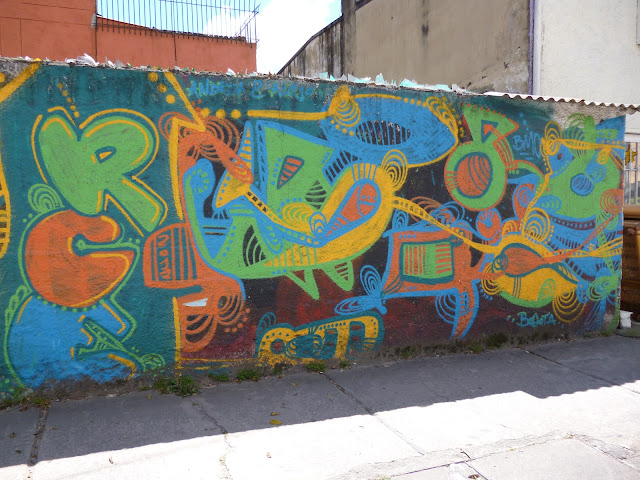
Another Bogota street artist that has reached some fame is Toxicomano. I really like his stencil style. They are really noticeable. Here is some work: http://www.benditomosquito.com/inusual/kolectivo-toxicomano/ and here: http://www.flickr.com/photos/toxicomano666/
Another friend has recently asked for people to share their favorite street art, and it included a really interesting list of people:
Banksy in London http://www.banksy.co.uk/ or http://www.boredpanda.com/80-beautiful-street-crimes-done-by-banksy/ https://www.artsy.net/artist/banksy
Vik Muniz in Brazil http://www.npr.org/2011/
http://www.pinksmith.com/ in New York
BLU http://blublu.org/
Jamie Hewlett http://en.wikipedia.org/
Shepard Fairey http://en.wikipedia.org/
Swoon (http://en.wikipedia.org/
Invader (http://en.wikipedia.org/
Lora Zombie (http://lorazombie.com/) is also fantastic.
Invader (http://en.wikipedia.org/
Lora Zombie (http://lorazombie.com/) is also fantastic.
Anyway, with this inspiration, I decided to start to collect photos of various graffiti in Bogota. There is some amazing stuff here (and some ugly tagging too).
 |
| Was so pleased to find this one -- a Stinkfish near Simon Bolivar's house. An old lady was living in the small park in front of it, and got very upset at me taking photos -- she probably thought I was taking them of her. |
 |
| A stenciled Jesus in a tiny corner of another piece, showing the religious connections in Colombia. |
 |
| I love this very simple, bad grammar that's really close to my house... it's poetic and such an interesting thing for someone to have chosen to write on the wall. |
 |
| Toxicomano in the corner, and other artists. In the middle is a cute smiley fish which is an interesting contrast to Stinkfish's evil grin. I've seen the smiley fish in quite a few places. |
 |
| Love this minute little stencil! |

 |
| My area! |
 |
| Mix of two types. |
 |
| More typical, less interesting. There is a lot of this sort of stuff around. |

Saturday, December 31, 2011
Bishapur ancient city, Iran
Bishapur
The city of Shapur, king of the Sassanids. A.D. 260
 About 2 hours drive out of Shiraz is another old city of Iran, Bishapur. It's half way to the Gulf, (coincidently, on the news today they announced that Iran will close the Straits of Hormuz if they don't remove the sanctions and allow oil to be sold!) through beautiful valleys of spectacular mountains and wild orchids.


 Narrow valleys with bas-reliefs up the side were damaged by a trough for a water mills and Muslim extremists hacking off parts of statues (though it does puzzle me why they went for the horse's tassels instead of something else more important). The city consisted of a super castle perched up on the side of the mountain, and hills and hills of unexcavated ruins. Mum and I were disappointed that the cave with the 7 meter high statue of Shapur that we had been looking forward to seeing was a 1 and a 1/2 hour walk up a cliff face that we did not have time for.

 However, one of the most remarkable things I've ever seen is Anahita's temple, which was a massive, very tidy stone courtyard 7 meters underground where there would have been a pool for worshippers. I've never seen an old city with something so big and open below the level of the land, and it was so well constructed with massive stone blocks that fitted together almost without mortar. A square corridor around it disappeared underground. It would have been a beautiful building and a beautiful pool, but the fact that it was so complete and intact and underground as well (the underground bit was what allowed it to be intact) were quite amazing!
Found it fascinating to imagine the 70,000 or so Roman soldiers (prisoners of war) that built the city. They had lost to Shapur, and I believe they lived the rest of their lives out there as punishment. Roman emperor Valerian mentioned that if he'd lost he would have had Shapur cut into bits and distributed in the hills so that the eagles could eat him (which somewhat complied with Zoroastrian beliefs, but not really), but Shapur built Valerian a palace so he could live out his days in this spectacular location. What would it be like to go off to fight and to never return to your home? Most of the soldiers would have been from all over the empire, and Iran is beautiful, but that is really a punishment in emotive proportions. Would there have been resentment or contentment? How have their genes dispersed down through Iran's lineage? We were talking yesterday about how Gengis Khan impregnated 500 women (or was it 100?) and now around 15 million people can trace their genetic code back to him across Asia and Europe. Where are the genes from those soldiers? Shouldn't everyone around here have blue eyes and blonde hair, although I recognize that's a stereotype.

 We wandered the palace and a massive domed reception hall (sans dome of course) while the sun set in front of us. Not another soul was around the entire time, and it was peaceful and relaxed. Mum said the ruins in Turkey were like that in the 70s, but now imagine they are as roped off and sterile as Persepolis is today. For moments I decide I like the organization and good management and preservation, but really, I am pretty sure that I prefer the freedom to roam wherever I wish and the romanticism that occurs to me in a wild site.
Was a bit disgusted by Lonely Planet's lack of info on the site, really. Just another example of money taking precedence over quality.
The city of Shapur, king of the Sassanids. A.D. 260


Found it fascinating to imagine the 70,000 or so Roman soldiers (prisoners of war) that built the city. They had lost to Shapur, and I believe they lived the rest of their lives out there as punishment. Roman emperor Valerian mentioned that if he'd lost he would have had Shapur cut into bits and distributed in the hills so that the eagles could eat him (which somewhat complied with Zoroastrian beliefs, but not really), but Shapur built Valerian a palace so he could live out his days in this spectacular location. What would it be like to go off to fight and to never return to your home? Most of the soldiers would have been from all over the empire, and Iran is beautiful, but that is really a punishment in emotive proportions. Would there have been resentment or contentment? How have their genes dispersed down through Iran's lineage? We were talking yesterday about how Gengis Khan impregnated 500 women (or was it 100?) and now around 15 million people can trace their genetic code back to him across Asia and Europe. Where are the genes from those soldiers? Shouldn't everyone around here have blue eyes and blonde hair, although I recognize that's a stereotype.


Was a bit disgusted by Lonely Planet's lack of info on the site, really. Just another example of money taking precedence over quality.
Tuesday, December 27, 2011
Ghesm Island, Iran
Flying from Shiraz to Ghesm showed amazing lines of dry mountains and winding riverbeds slowly turn into drastic cliffs and scrubby desert.
We landed and were impressed by the tourist information booth ('Seven wonders of the Persian Gulf') and the on site diving incubator! We joined the swarm for a taxi, finally getting in one, we pondered how much it would cost as there was no meter. How hard to bargain? Then we saw that it was 45km to town and were glad we hadn't asked as it would probably have just shocked us! However, as is reasonable Iran, it ended up only being $15.
We got to the Diplomat Hotel whose tiny zoo-like lobby was a fascinating look into the travelers of Ghesm. A sign on the wall warned that all women must wear Islamic dress including the hijab, but a glance around had three very heavily painted women: one with a bandana tied scarf and stray hairs poking out around her bare neck (forbidden), one African looking woman with all purple (colors are frowned upon), and short Capri pants (legs!), and while the third was properly covered, her casual seat on the front steps and her flouncing around in her flowing abaya showed she felt very comfortable around all the many men that overflowed the well-used seats. At first we thought they were prostitutes but then we discovered their plight: they are all women from Dubai on visa runs. We later discovered that one was a Nigerian woman who had been stuck here for a week waiting for her visa and trapped like a prisoner with no money! She told us of someone else who was stuck here for 3 months. They are at the complete mercy of the Dubai government bothering to send them the visa letter fax, and often get stuck with no money and no hopes on this island and more famous Kish Island, both Duty Free ports. They all thought we were insane to be tourists in what they considered a god-forsaken place. It was interesting, if tragic, nevertheless. This is also the first time in a long while that I've had a squatter toilet in my room.
Wow, what a forgotten corner of the world this is! It was touted to be like the gulf was before the oil boom and does seem like it, and we had no idea how large the island was until we got here. 160km of very little except spectacular land formations and wild deserts that must be awfully hot in summer. We sat in our hotel watching the (smuggling) speedboats zip across the harbor contrasting with the newly constructed mosque with half -finished zellij tile decorations going up the 4 minarets, preparing to go to the Portuguese fort here in ancient-but-you-wouldn't-know-it-Ghesm-town.
We ate a scrumptious local dish for dinner from a little cafe because we couldn't be bothered waiting for the restaurants to open at 8pm. The eating of 'Dizi' is best summed up by the Lonely Planet:
"Getting dizi
Known alternatively as abgusht (or as piti in Azerbaijan, though I never saw it there) dizi is a cheap soup-stew meal named for the earthenware pot in which it's stewed (ours was metal). It's considered by many Iranians as the old of the poor. But assuming you're neither a vegetarian nor obsessive about cholesterol, it's actually a delicious and filling dish. There is, however, an art to eating it. First, drain off the soupy broth into a bowl full of bread that you've previously ripped into bite-sized morsels. Eat this stew the turn to the main ingredients: chickpeas, potatoes, tomatoes, and soft-boiled mutton. Grind these together using a provided metal pestle that looks disturbingly like a stylized toilet plunger. Do include the inevitable chunk of fat; it might look unappetizing but adds to taste and texture. Eat the resulting mush with a spoon or bread."
Day 2


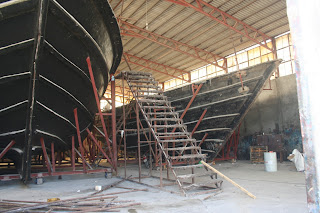

 A day to go around the island and see the seven wonders of the gulf. We started off at the dhow yards where we contrasted the wooden ones with the fiberglass ones. It was interesting to see how fiberglass is made. This was the period when Iran was testing nuclear missiles in the Gulf and threatening to close the Straits of Hormuz. We saw many military jets zooming overhead while we criss-crossed the sand piles.

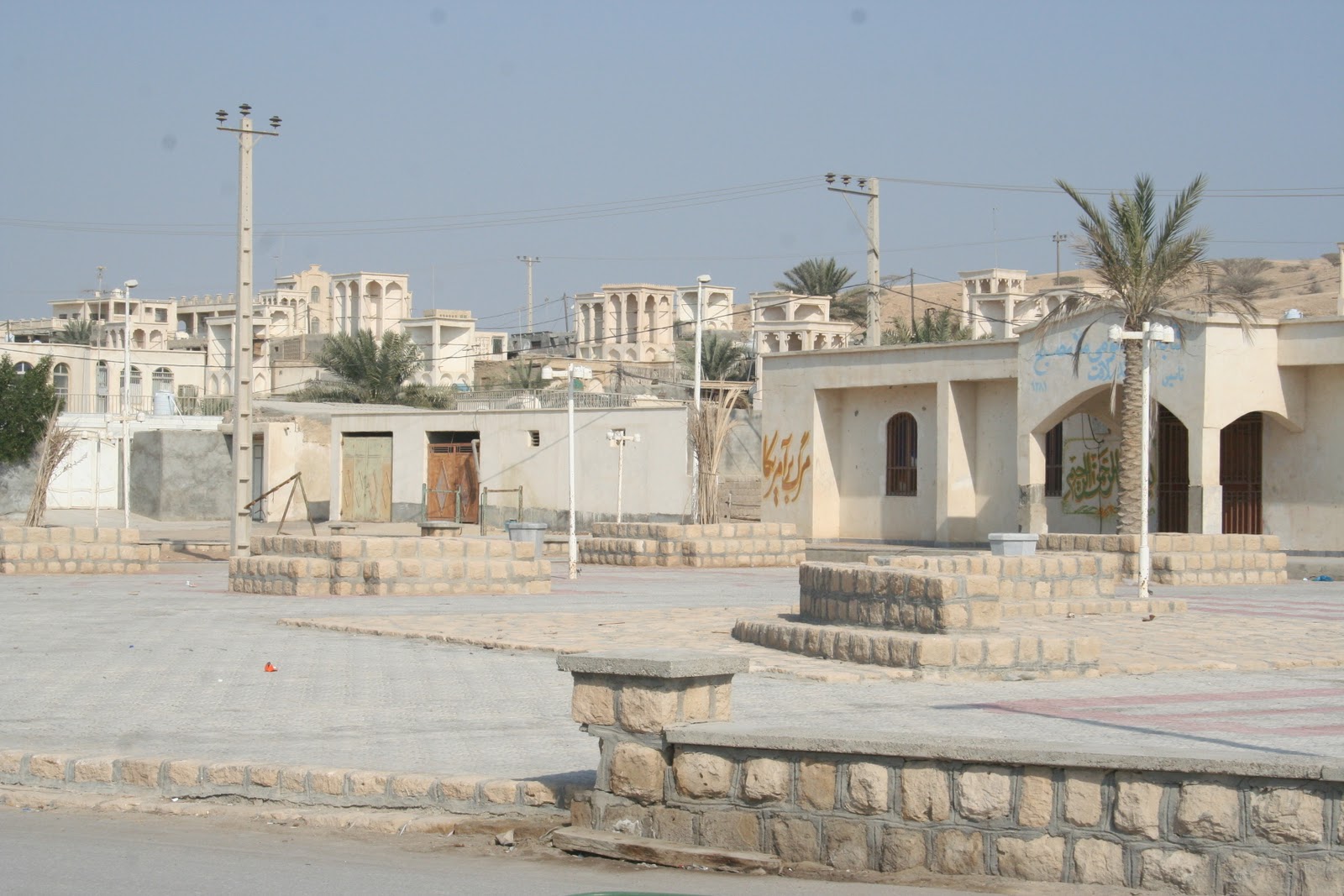
 Then we went on to the town of Laft where they are still using the ancient system of air conditioning, the wind towers called bagdirs. It was lovely to see the boats lined up in front of the town as it unfolded down the hill. The mangrove forests were amazing. 9000 square hectares, with dolphins, storks, pelicans, seagulls and other birds. We even prevented our boat driver from pulling a nest out of a particularly old tree.


The two geological formations we visited, Chah Kuh Valley and the Valley of Fallen Stars were spectacular. Water erosion has created spectacular winding valleys to walk down and climb up, and we all got as dusty as we could. We finished the day at Khorbas cave which was a couple of houses carved out of the cliff whose tunnels we explored in the dark as the sun had already set.
Day 3
We took a tiny speedboat ferry across to mainland Iran, making bets as to whether they would check our passports (we were thinking of the ladies at the Diplomat Hotel making their escape!). They didn't. No jets or missiles either! We arrived into Bandar Abbas, one of the many bandars (ports) along the coast, and taxied to the little town of Minab, which has a famous Thursday market. Anyone else would think we were crazy to go so far just to see oranges and abayas on sale, but it was a fascinating mix of people, with a snake charmer, toothless old ladies, and an amazing collection of people going about their business.
Day 4
White caps on the sea cancelled our desires to ferry across to see the large fort on Hormuz Island, which we could see in the distance at sunrise and sunset. Instead we lazed in the sun and read.
We landed and were impressed by the tourist information booth ('Seven wonders of the Persian Gulf') and the on site diving incubator! We joined the swarm for a taxi, finally getting in one, we pondered how much it would cost as there was no meter. How hard to bargain? Then we saw that it was 45km to town and were glad we hadn't asked as it would probably have just shocked us! However, as is reasonable Iran, it ended up only being $15.
 |
| The view from the Diplomat Hotel in Ghesm town. Hormuz Island is on the horizon but difficult to see. |
Wow, what a forgotten corner of the world this is! It was touted to be like the gulf was before the oil boom and does seem like it, and we had no idea how large the island was until we got here. 160km of very little except spectacular land formations and wild deserts that must be awfully hot in summer. We sat in our hotel watching the (smuggling) speedboats zip across the harbor contrasting with the newly constructed mosque with half -finished zellij tile decorations going up the 4 minarets, preparing to go to the Portuguese fort here in ancient-but-you-wouldn't-know-it-Ghesm-town.
 |
| The stew that is dizi... the mixed vegetables before and after! |
"Getting dizi
Known alternatively as abgusht (or as piti in Azerbaijan, though I never saw it there) dizi is a cheap soup-stew meal named for the earthenware pot in which it's stewed (ours was metal). It's considered by many Iranians as the old of the poor. But assuming you're neither a vegetarian nor obsessive about cholesterol, it's actually a delicious and filling dish. There is, however, an art to eating it. First, drain off the soupy broth into a bowl full of bread that you've previously ripped into bite-sized morsels. Eat this stew the turn to the main ingredients: chickpeas, potatoes, tomatoes, and soft-boiled mutton. Grind these together using a provided metal pestle that looks disturbingly like a stylized toilet plunger. Do include the inevitable chunk of fat; it might look unappetizing but adds to taste and texture. Eat the resulting mush with a spoon or bread."
Day 2




 |
| The view from Khorbas cave. |
 |
| Valley of the Fallen Stars. |
 |
| Valley of the Fallen Stars. |
 |
| Chah Kuh Valley. |
Day 3
We took a tiny speedboat ferry across to mainland Iran, making bets as to whether they would check our passports (we were thinking of the ladies at the Diplomat Hotel making their escape!). They didn't. No jets or missiles either! We arrived into Bandar Abbas, one of the many bandars (ports) along the coast, and taxied to the little town of Minab, which has a famous Thursday market. Anyone else would think we were crazy to go so far just to see oranges and abayas on sale, but it was a fascinating mix of people, with a snake charmer, toothless old ladies, and an amazing collection of people going about their business.
Day 4
White caps on the sea cancelled our desires to ferry across to see the large fort on Hormuz Island, which we could see in the distance at sunrise and sunset. Instead we lazed in the sun and read.
Subscribe to:
Posts (Atom)